





When Charlie Chaplin’s Body Was Stolen After Burial
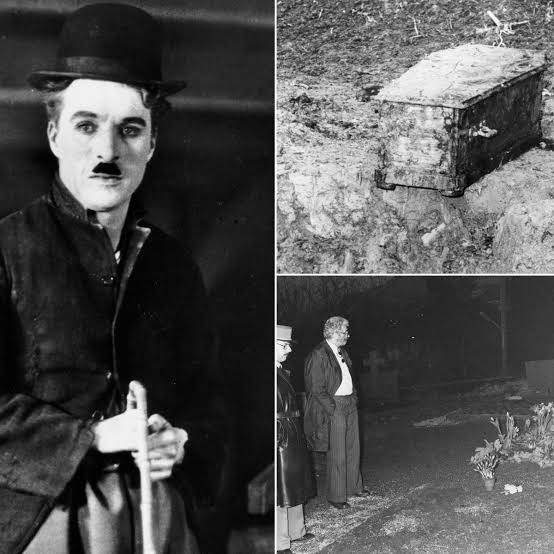
In one of the most bizarre crimes linked to a global icon, the body of legendary silent film star Charlie Chaplin was stolen from his grave in 1978, just months after his burial in Switzerland.
Chaplin, who died peacefully on Christmas Day 1977 at the age of 88, was laid to rest in a quiet cemetery in Corsier-sur-Vevey, Switzerland. However, on the night of March 1–2, 1978, two unemployed mechanics—24-year-old Roman Wardas and 38-year-old Gantscho Ganev—dug up his grave and stole the coffin.
The duo transported the coffin and hid it in a cornfield near the village of Noville. Wardas, described as the mastermind, carried out the act in hopes of raising money to open his own auto repair shop.
Shortly after, the thieves contacted Chaplin’s widow, Oona Chaplin, demanding a ransom of 600,000 Swiss francs (approximately $600,000). However, Oona refused to pay, stating that Charlie Chaplin would have found the situation “ridiculous.”
As the investigation intensified, police monitored hundreds of telephone booths and tapped the Chaplin family’s phone line. Meanwhile, multiple fake ransom notes from opportunists added confusion to the case.
To prove they had the body, the real kidnappers sent a photograph of the coffin in the cornfield. Eventually, after weeks of surveillance, police arrested Wardas and Ganev on May 16, 1978.
In a strange twist, the suspects could not even remember the exact burial spot in the large field. Officers later used metal detectors to recover the coffin.
Wardas was convicted as the main planner and sentenced to four and a half years of hard labour, while Ganev received an 18-month suspended sentence for his lesser role.
Chaplin’s remains were returned to his original cemetery, where his coffin was later reburied deep underground inside a reinforced concrete vault to prevent any future disturbance.
The unusual case later inspired the film The Price of Fame, highlighting one of the most shocking celebrity-related crimes in history.
Report Sabih Salik