









UNITED NATIONS SDGs …..
The United Nations Sustainable Development Goals (SDGs) are a universal call to action to end poverty, protect the planet, and ensure peace and prosperity for all by 2030. Adopted in September 2015 by all 193 United Nations member states, the SDGs build upon the success of the earlier Millennium Development Goals (MDGs) while addressing their shortcomings. Unlike the MDGs, which primarily focused on developing countries, the SDGs are universal, applying to every country, rich or poor, with an integrated approach recognizing the interdependence of economic growth, social inclusion, and environmental sustainability.
The SDGs consist of 17 interconnected goals and 169 targets, covering a broad range of issues critical to human and planetary well-being. The first goal, No Poverty, seeks to eradicate extreme poverty and reduce inequalities, acknowledging that poverty is not only about income but also access to essential services like healthcare, education, and social protection. The second goal, Zero Hunger, aims to end hunger, achieve food security, and promote sustainable agriculture. These goals highlight the importance of equitable access to resources and the necessity of addressing both social and economic dimensions of development.
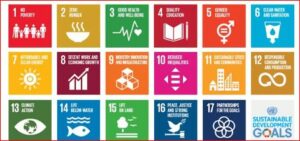
Quality Education (Goal 4) emphasizes inclusive, equitable, and quality education for all, recognizing education as a fundamental driver of sustainable development. Similarly, Gender Equality (Goal 5) seeks to empower women and girls, eliminate discrimination, and promote participation in decision-making at all levels. These social goals underscore the UN’s commitment to human rights, social justice, and equality.
Economic growth is addressed through goals such as Decent Work and Economic Growth (Goal 8), which promotes productive employment and entrepreneurship, and Industry, Innovation, and Infrastructure (Goal 9), which focuses on building resilient infrastructure, fostering innovation, and supporting sustainable industrialization. These goals aim to create inclusive, resilient economies capable of adapting to changing global conditions.
Environmental sustainability is central to the SDGs. Goals like Clean Water and Sanitation (Goal 6), Affordable and Clean Energy (Goal 7), Climate Action (Goal 13), Life Below Water (Goal 14), and Life on Land (Goal 15) address critical ecological challenges. They emphasize the need to conserve natural resources, reduce greenhouse gas emissions, protect marine and terrestrial ecosystems, and promote sustainable consumption and production patterns. These objectives recognize that environmental degradation directly impacts human health, economic stability, and social equity.
The SDGs also stress the importance of strong institutions and global partnerships. Peace, Justice, and Strong Institutions (Goal 16) aim to reduce violence, promote the rule of law, and ensure accountable governance, while Partnerships for the Goals (Goal 17) call for collaborative efforts between governments, the private sector, civil society, and international organizations. Achieving the SDGs requires global cooperation, innovative financing, and knowledge-sharing, as challenges like climate change, pandemics, and inequality transcend national boundaries.
One of the SDGs’ most notable features is their interconnected nature. Progress in one goal often supports progress in others. For example, improving education can reduce poverty, empower women, and promote economic growth. Similarly, sustainable agricultural practices help end hunger, conserve ecosystems, and combat climate change. This systemic approach ensures that development strategies are holistic rather than isolated….

Despite significant progress, achieving the SDGs remains a major global challenge. Issues like climate change, geopolitical conflicts, economic disparities, and the COVID-19 pandemic have slowed progress in many areas. However, the SDGs provide a shared framework and vision, guiding governments, organizations, and individuals toward a sustainable, equitable, and prosperous future.
In conclusion, the United Nations SDGs represent a transformative agenda for humanity. By addressing social, economic, and environmental dimensions simultaneously, they offer a roadmap to build a world where poverty is eliminated, resources are sustainably managed, and all people enjoy equality, dignity, and opportunity. Their success depends on collective action, innovation, and unwavering commitment from every sector of society, making the SDGs a blueprint not just for development but for a sustainable and just world.