







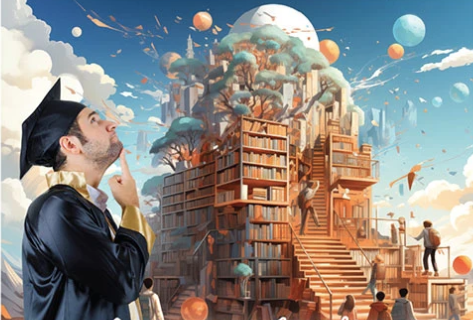
Where are the nurseries of knowledge and consciousness, the lighthouses of light?
By Shah Waliullah Junaidi Karachi
===============
The city of Karachi was once considered a shining center of knowledge, research, and intellectual maturity. It was not only a hub of economic activity, but its educational institutions were also regarded as symbols of academic standards and educational prestige. What an era it was when graduates from Karachi’s colleges and universities achieved prominent positions nationally and internationally, brightening Pakistan’s name. But today, those same institutions seem to be struggling to maintain their former academic glory.
In the past, educational institutions were not just places of learning, but centers of personality development, character building, and leadership training. During the time when Karachi’s Collector was Captain Preedy, the CMS High School was established in 1854 for the common citizens through his efforts. Initially called the “Free School,” it was later renamed the Church Missionary Society School.
This institution was also unique because it provided English education, which was considered a symbol of modern education in that era. The Father of the Nation, Quaid-e-Azam Muhammad Ali Jinnah, received his early education from this school. Persian and Sindhi were also taught there.
At that time, the fee for Persian was four annas, and for Sindhi, one anna was set; however, in the same year, 1854, Sindhi language education was declared free. Today, this historic institution appears unable to maintain the standards of its past. Similarly, Sindh Madressatul Islam is counted among Karachi’s oldest and most respected academic centers.
This institution was founded on September 1, 1885, by the renowned educationist and social leader Hassan Ali Effendi. This institution is not only an important chapter in Karachi’s academic history but also holds the honor of being the alma mater of the Father of the Nation, Quaid-e-Azam Muhammad Ali Jinnah.
Among those who benefited from Sindh Madressatul Islam are, besides Quaid-e-Azam Muhammad Ali Jinnah, Sir Abdullah Haroon, Sir Shah Nawaz Bhutto, Sir Ghulam Hussain Hidayatullah Khan, Ayub Khuhro, Sheikh Abdul Majid Sindhi, Allama I.I. Kazi, Muhammad Hashim Gazdar, Ghazanfar Ali Khan, Chaudhry Khaliquzzaman, Dr. Umar bin Muhammad Daudpota, Muhammad Ibrahim Joyo, Justice Sajjad Ali Shah, Qazi Muhammad Isa, Rasool Bux Palijo, A.K. Brohi, Ali Ahmed Brohi, Pir Ilahi Bakhsh, and countless other scholars, poets, writers, lawyers, and politicians.
This institution was once such a nursery of knowledge and consciousness and a lighthouse of light that, through its students, it brightened the name of Pakistan in the country and abroad. Today, few towering and versatile personalities from this great seat of learning are rekindling its former traditions on a global level.
St. Patrick’s School and College is a famous Roman Catholic institution. This educational institution was established on January 16, 1861. Many prominent figures of the country have studied here, including former Army Chief and President General Pervez Musharraf, former Prime Minister Shaukat Aziz, President Asif Ali Zardari, and renowned bureaucrat Abdul Karim Lodhi. These are individuals who performed outstanding services in their respective fields.
DJ Sindh Government Science College, Karachi, is counted among the city’s oldest educational institutions, and today it remains a shining name on the city’s educational horizon. The foundation of this institution was laid in 1887 by Seth Diaram Jethmal, a prominent Hindu lawyer, philanthropist, and social leader of Sindh. Initially, the institution was established in a house within the Thathai Compound on M.A. Jinnah Road.
Due to the increasing number of students, the foundation stone for its current building was laid on November 14, 1887, the same year. Over time, this institution became one of the prominent academic centers of Karachi and Sindh. Among the graduates of this institution are prominent Sindhi leader Ghulam Hussain Hidayatullah, former President of Bangladesh Ziaur Rahman, “Mohsin-e-Pakistan” (Benefactor of Pakistan) and nuclear scientist Dr. Abdul Qadeer Khan, prominent nuclear scientist Dr. Badr-ul-Islam, and NASA-affiliated scientist Sheikh Liaquat Hussain.
Heads of Pakistan’s armed forces, General Jehangir Karamat and General Asif Nawaz Janjua, Air Marshal Azim Daudpota, former Chief Minister of Sindh Muhammad Ayub Khuhro, prominent politician Imdad Ali Bhutto, and current Chief Minister of Sindh Syed Murad Ali Shah, also studied at this institution.
Graduates of this institution have also performed outstanding services in the fields of social service and medicine. Dr. Adib-ul-Hasan Rizvi (Head of SIUT) and Dr. F.U. Baqai, a prominent figure in medical education, are also representatives of this institution’s academic tradition.
In the political and social fields, leaders like Mehmoud A. Haroon, Muzaffar Hussain Shah, former Speaker of the National Assembly Ilahi Bakhsh Soomro, Nisar Khuhro, former Federal Minister Abdul Hafeez Pirzada, Taj Haider, Nisar Memon, and Javed Sultan Japanwala have also been associated with this institution.
The role of DJ College is also very bright in the world of knowledge and literature. Former Vice-Chancellor of the University of Karachi, Dr. Pirzada Qasim Raza Siddiqui, renowned researcher Dr. Nabi Bakhsh Baloch, former Principal of SM Science College Professor Hashmatullah Lodhi, prominent Sindhi poet Shaikh Ayaz, and renowned educationist Professor Anita Ghulam Ali are shining links in this academic tradition.
In the field of sports, students of this institution have also brought prominence to Pakistan globally. Prominent national hockey team players Hassan Sardar, Munawwar-uz-Zaman, Shahid Ali Khan, and Safdar Abbas grew up in the educational and training environment of this institution. All these personalities are proof that DJ College is not just an educational institution, but a historic seat of learning that has established bright examples of leadership, knowledge, and service in various fields of society.
In the 1960s, the “Father of Urdu,” Maulvi Abdul Haq, established Urdu College in Karachi through his personal efforts, determination, and financial resources. The primary purpose of establishing this institution was not just to create a place of learning, but to give birth to an intellectual movement through which doors to higher education in the Urdu language could be opened.
Maulvi Abdul Haq believed that the intellectual and educational progress of a nation is possible only when students have the opportunity to acquire knowledge in their national language. After its establishment, Urdu College quickly became one of Karachi’s important educational institutions. Not only was the teaching standard promoted, but a rich tradition of literary and intellectual activities was also established.
Countless graduates of this institution have achieved prominent positions in various walks of life and proven their mettle. However, while the institution appears to have expanded and developed in terms of its buildings and administrative structure, no major name has emerged in the last two decades regarding academic standards and scholarly personalities that would fully represent the continuity of its former academic tradition. The fundamental spirit and objectives of this institution need to be revived so that this seat of learning can once again become an active center of knowledge and research.
Abdullah Haroon College, Lyari, is also counted among the important educational institutions of Karachi. Established against the historical and cultural backdrop of Lyari, this college was once a prominent center of academic and intellectual awakening. The great progressive poet and intellectual of the subcontinent, Faiz Ahmad Faiz, served as a teacher here.
Abdullah Haroon College not only limited itself to formal education but also promoted consciousness, thought, and social awareness among students. Many students who graduated from this institution have held prominent positions in literature, journalism, social services, and government and private organizations. This college proved to be a strong center of knowledge, awareness, and social consciousness for the youth of Lyari.
NED University of Engineering and Technology is also a historic and prominent educational institution in Karachi. Recognizing the need for expert and trained engineers during the great project of building the Sukkur Barrage, the Prince of Wales Engineering College was founded in 1921.
The primary purpose of this institution was to produce capable and skilled civil engineers who could play an effective role in major construction projects like the Sukkur Barrage. In 1924, this institution received a substantial donation of one hundred and fifty thousand rupees from the heirs of the renowned social and business figure Nadirshaw Edulji Dinshaw. In recognition of this financial support, the college’s name was changed to NED Government Engineering College.
Until 1947, before the establishment of Pakistan, this institution remained affiliated with the University of Bombay for several years during British rule. Due to this affiliation, engineering education held a prominent position in the subcontinent in terms of academic recognition and standards. This institution has provided Pakistan with countless capable engineers, scientists, and experts—not only that, but it has produced competent and talented individuals in various fields including politics, education, sports, and business.
**Where are the nurseries of knowledge and consciousness, the lighthouses of light?**
The name of the University of Karachi is also extremely important in Karachi’s academic history. Established in 1951, this university is counted among Pakistan’s major universities. There was a time when the University of Karachi held a distinguished position throughout the country in terms of research, teaching, and academic activities. Its faculty and students made valuable scholarly contributions in science, literature, economics, sociology, and other fields.
Educational institutions were not merely centers of teaching and learning; they were intellectual and social factories from which talented individuals emerged for leadership, research, literature, politics, and sports. In the atmosphere of these institutions, not only bookish knowledge but also consciousness, character, and a sense of responsibility were nurtured.
In the past, several renowned scholars, scientists, and educationists who graduated from this great institution proved their mettle not only in Pakistan but globally. Among them are eminent scholars like Dr. Salim-uz-Zaman Siddiqui, Abdul Qadeer Khan, Atta-ur-Rahman, and I.H. Qureshi, who rendered invaluable services in the fields of research, science, and education.
All these personalities represent the academic and intellectual heritage of the University of Karachi. Their services are proof that the University of Karachi is not just an educational institution, but a center of knowledge, research, and intellectual guidance. Its graduates have continued to play a significant role in the intellectual and academic formation of society. This is why, in the past, government educational institutions were considered symbols of academic prestige and educational standards.
The identity of institutions like Government Delhi College, Government Adamjee College, and Government College Nazimabad was not merely defined by their buildings or curricula, but by the hard work, honesty, and academic insight of those teachers who considered teaching not just a profession but a national service.
Similarly, in the field of women’s education, institutions like Government College for Women, Government Karachi Girls College, and Government Sir Syed Girls College were counted among the city’s educational centers where education was not considered merely a means to pass exams, but a tool for personality development, intellectual maturity, and fostering social consciousness. Their intellectual training was done through debates and literary activities, and their talents were also honed on the sports field.
Today, that academic atmosphere, love for reading, and educational standard are not as they used to be. The question is: Have those dedicated and talented teachers ceased to exist, or has the passion for acquiring knowledge among students, which was once the hallmark of these institutions, faded? The truth is likely hidden somewhere between these two factors.
This situation demands a serious examination of this lost academic tradition of government educational institutions and efforts to revive it. The true strength of any nation lies in its educational institutions. It is from these institutions that the generation emerges which determines the intellectual, social, and national direction of society in the future. When educational institutions are strong, the foundation of the nation is also stable. When their light begins to dim, the intellectual direction of society also begins to blur.