







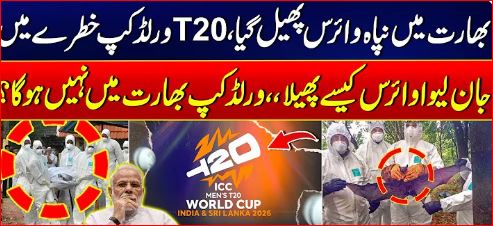
NIPA VIRUS EFFECTS WORLD CUP T20 2026 ? WOULD BE POSTPONED ???
The question has gained traction because the 2026 ICC Men’s T20 World Cup is scheduled to be hosted by India and co-hosted by Sri Lanka in February–March 2026. With recent confirmed Nipah virus infections in India, including cases in West Bengal, concerns have bubbled up over whether the virus poses a threat to the tournament’s safe conduct.
What is the Nipah Virus?
The Nipah virus (NiV) is a rare but very serious zoonotic pathogen that can move from infected animals (especially fruit bats) to humans, and in some cases between people. It causes symptoms ranging from fever and respiratory illness to deadly brain inflammation (encephalitis). Fatality rates are extremely high, currently estimated between 40 % and 75 %, and there is no licensed vaccine or specific antiviral treatment.
Outbreaks have historically been localized to parts of Asia — chiefly Bangladesh and India — and have occurred sporadically over the past few decades. Human-to-human spread usually requires close or prolonged contact.
Current Situation (Jan–Feb 2026)
In January 2026, two Nipah virus cases were confirmed in West Bengal, India, leading to enhanced health monitoring and tracing of nearly 200 contacts. Local authorities have stated that the situation is contained, and all traced contacts tested negative.
Meanwhile, regional responses have included tightened airport screening and thermal checks across Asia — including in Pakistan, Singapore, Thailand, Malaysia, Hong Kong, Indonesia, and Vietnam — to monitor travelers for symptoms and recent exposure history.
Importantly, the World Health Organization (WHO) has noted that while the Nipah virus is dangerous, the risk of spread beyond India remains low at this stage, and they are not recommending travel or trade restrictions related to the outbreak.
The T20 World Cup 2026 Context
The ICC Men’s T20 World Cup is one of the biggest global sporting events, drawing players, officials, media, and fans from dozens of countries. For many nations — including Pakistan, England, Australia, South Africa, West Indies, Bangladesh, and host India — it’s a pinnacle event steeped in international travel and mass gatherings.
In such a setting, even a small public-health scare can produce outsized concerns, especially after the global disruption caused by the COVID-19 pandemic just a few years ago.
Several sports journals and analysis outlets have already reported that the Nipah situation could “add a new public-health challenge to an already contested World Cup”, focusing on safety, scheduling, and travel arrangements.
What Could Go Wrong?
Here are some ways the Nipah outbreak could (hypothetically) affect the T20 World Cup:
1. Player and Official Safety Concerns
Traveling teams and support staff may be worried about exposure, especially if they are scheduled to play or train in regions near outbreak zones. Cricket boards might insist on health guarantees, isolation protocols, or even altering match venues if they perceive undue risk.
2. Travel Restrictions and Screening Delays
Heightened screenings at airports (like thermal checks and travel history screenings) could delay international travel plans. Players, officials, and fans may face longer border controls or additional health reporting requirements, adding logistical stress to an already tight tournament schedule.
3. Fan Attendance and Tourism Impact
If fans fear getting sick or have to go through stringent screening or quarantine rules, ticket sales or travel plans could be negatively affected. Hospitality sectors in host cities — hotels, restaurants, public transport — could see reduced demand.

4. Media and Public Perception
Even if the actual risk of Nipah transmission at a sports event is low, media amplification can heighten psychological fear. Talks about shifting matches or questioning host safety can feed public anxiety, affecting attendance and reputation.
So, Will It Impact the Tournament?
At this point, major international health bodies and Indian authorities report that the outbreak is limited and controlled, with no evidence of large-scale spread or explosive clusters. The WHO says no broad travel bans are needed and emphasizes that Nipah transmission is not easily airborne like influenza or some forms of coronavirus.
That means the immediate scientific risk to the T20 World Cup — in terms of a large outbreak directly tied to the event — is low.
However, risk perception and precautionary behavior sometimes matter as much in large events as actual epidemiology.
Measures Cricket Authorities Could Take
To keep the tournament safe and smooth, organizers (ICC and host boards) will likely adopt several measures:
Enhanced health surveillance for players and support staff around match venues.
Pre-travel health screening and risk questionnaires for international teams.
Public health advisories for fans, especially those traveling from regions with known cases…

Coordination with national health authorities for rapid response if any case is detected among travelers or attendees.
Such measures are standard in large events, especially after outbreaks of viruses like Ebola, Zika, and COVID-19 in previous years.
Conclusion
The Nipah virus is a serious public-health concern in regions where outbreaks occur. Its high severity and lack of vaccine make it scary, and its presence in India ahead of the 2026 T20 World Cup has understandably raised questions among fans and media alike.
However, based on available evidence as of January 2026, the outbreak remains limited, with strong containment efforts and no significant ongoing transmission reported beyond a small cluster in West Bengal. Additionally, the WHO considers the risk of global spread to be low, and major travel or event cancellations are not currently advised.
Thus, while precautions and monitoring are warranted, the likelihood that the Nipah virus will directly derail, postpone, or shift the T20 World Cup 2026 appears to be unlikely at present — assuming containment efforts continue to hold and no new large outbreak emerges before the tournament…..