






Women’s Land Ownership in Sindh: The Facts vs Assumptions
Women’s Land Ownership in Sindh: The Facts vs Assumptions
By AGHA FAKHUR HUSSAIN DURRANI
Discussions around women’s land ownership in Pakistan are often framed around assumptions rather than evidence. Popular narratives frequently suggest that women’s ownership is negligible — sometimes claiming it is almost nonexistent. However, the digitized land records of Sindh province tell a different story, one grounded in verifiable, official data.
Sindh has been systematically digitizing its land records under the Land Administration and Revenue Management Information System (LARMIS). Historical records up to 2010 were scanned and indexed, while routine mutations, registries, and e-registrations have been continuously integrated. Gender-disaggregated data from these records, alongside Provincial Record Cell (PRC) databases and the new e-Registration system (from February 2024), provide an authentic view of property ownership by women in the province.
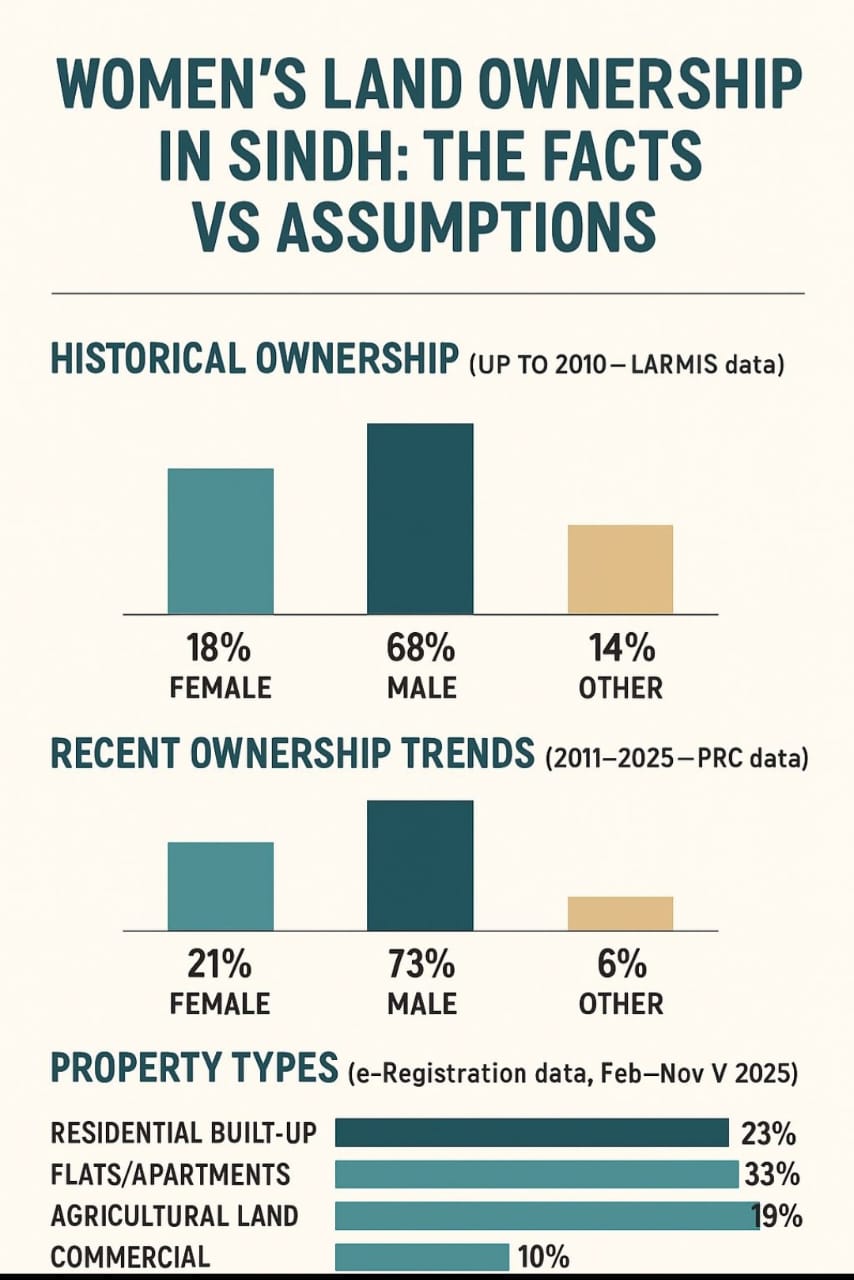
The data reveal that as of 2010, women constituted 18% of all landowners in Sindh. Breakdown by record type shows consistent female representation: VF-7B at 19%, VF-7A at 14%, and VF-2 at 13%. These figures challenge the widespread perception that women hold almost no land.
More recent transactions reinforce a positive trend. From 2011 to 2025, women represented 21% of all fresh property transactions, with 23% in VF-7B records, 16% in VF-7A, and 17% in VF-2. Early data from the e-Registration system in 2025 further highlight women’s significant presence across property types, including 23% of residential built-up properties, 33% of flats/apartments, and 19% of agricultural land. Notably, shared ownership also shows meaningful female participation, particularly in residential and multiple-property holdings.
These figures are important for two reasons. First, they provide factual evidence to counter the assumption that women in Pakistan are largely excluded from property ownership. Second, they underscore the value of digitized, verifiable land records in tracking and promoting gender equity in property rights.
While challenges remain, including ensuring equal inheritance rights and access to land in rural areas, Sindh’s experience shows that women are increasingly visible in the property market, and progress is measurable. Policymakers, researchers, and the media must use such authentic data as the foundation for discussion and planning — moving beyond anecdote and assumption toward evidence-based understanding and action.
( VF-7A = original / base ownership records (mostly agriculture),
• VF-7B = transfer / mutation history (agriculture),
• VF-II = urban / non-agricultural land/property register. )