



Digital tools, financial awareness to strengthen Sindhi women’s resilience to economic, climate shocks: Saeed Ghani
EU and Germany backed DFLT Initiative Launched in Sindh to Advance Women’s Digital and Financial Empowerment
KARACHI, Dec 01, 2025 ( ): Sindh Minister for Labour and Social Protection, Saeed Ghani, launching the Digital and Financial Literacy Training (DFLT) Programme, on Monday said equipping women with digital tools, financial awareness, and confidence would help them engage in the workforce, manage household resources more effectively, and strengthen their resilience to economic and climate-related shocks.
The Sindh Social Protection Authority (SSPA) has launched the Digital and Financial Literacy Training (DFLT) programme, an initiative supported by the European Union and the German Government through GIZ and implemented by the Sustainable Development Policy Institute (SDPI), to strengthen women’s ability to use digital platforms and financial services across the province.
The programme aims to strengthen women’s access to social protection and enhance their ability to use digital and financial services with confidence. By equipping women across Sindh with practical digital skills, safer transaction practices, and improved financial awareness, the DFLT initiative contributes to greater inclusion, accountability, and economic empowerment in the province.
Speaking at the ceremony, Saeed Ghani said the initiative aligns with the Sindh Government’s broader vision under the Pakistan Peoples Party to empower people not only to survive but to thrive. He noted that social protection and labour empowerment “are two sides of the same coin,” and that expanding access to digital tools, banking channels, and financial capability is essential for women’s socioeconomic mobility. He added that the DFLT programme complements Sindh’s landmark policy reforms, including the provincial government’s decision to provide asset ownership to flood-affected women, giving them legal property rights for the first time. “Such historic steps become far more meaningful when women also understand digital banking, financial planning, and savings behaviour,” he said, reaffirming strengthened coordination between SSPA and PDMA to build climate-resilient and adaptive protection systems in Sindh.
Jeroen Willems, Head of Cooperation at the EU Delegation to Pakistan, emphasized that the initiative represents a critical pillar of the EU’s support to adaptive social protection, disaster-risk reduction, and climate resilience. Calling digital and financial literacy a “golden opportunity,” he said the training would help assess the needs of rural women while also incorporating modules on climate awareness, responsible parenting, and nutrition. He highlighted that while nearly 25,000 women trained earlier under similar initiatives had already improved their disaster preparedness and resilience, the EU now aims with the Government of Sindh to reach 60,000 women by spring 2026. Willems noted that data still shows significant gaps in women’s access to financial services and savings behaviours, and that without basic knowledge of digital transactions, women remain excluded from pathways to economic security. “Digital and financial skills are essential for participation in today’s economy,” he reiterated.
Meriem El Harouchi, First Secretary at the EU Delegation to Pakistan, said the DFLT programme is central to the EU–Sindh Government partnership on inclusive social protection. She stressed that while the world is becoming “hyper-digitalised,” the most marginalized women particularly in rural areas still lack the confidence to use basic phone functions, digital wallets, or financial tools.
Training women to use these technologies, she said, gives them a vital cushion against financial and climate-related risks, while also improving gender equality, responsible parenting, and family well-being. Citing global evidence, she stated that women reinvest nearly 90% of their income into their families and communities, underscoring the transformative impact of financially empowered women. “Digital financial tools can act as a silver bullet for women’s empowerment, especially for non-banked populations in hard-to-reach areas,” she added.
Dr Abid Qaiyum Suleri, Executive Director of SDPI, said the DFLT initiative embodies a shared resolve to ensure that women especially those in climate-affected communities are not left behind in Pakistan’s digital transformation. He commended the Sindh Government for setting a strong precedent by providing women property ownership after the floods, but noted that such progressive steps can only achieve their full potential when paired with digital and financial literacy. “Training, financial tools, and the systems that connect them form a triangle. If any side is missing, the effort becomes unfruitful,” he said. He added that SDPI, GIZ, and SSPA are jointly strengthening this triangle, while SDPI serves as a catalyst. He also offered his full support as Chairman of the Board of NDRMF to helping Sindh scale inclusive, women-centred, community-driven social protection interventions.
SSPA CEO Irshad Ali Sodhar said rural communities in Sindh face significant gaps in both financial and digital literacy, making this initiative critical to empowering women and strengthening household well-being. He said the programme builds upon earlier successes such as the *Mamta initiative*, which improved maternal and child nutrition outcomes, and now expands its scope to help women access traditional banking and adopt savings-oriented financial behaviours. He welcomed GIZ’s partnership with SDPI, acknowledging SDPI’s expertise in sustainability and evidence-based programming. “SSPA and the Sindh Government extend their full support to this initiative, which is timely, relevant, and deeply aligned with our priorities,” he said.
Johanna Knoess, Head of Adaptive Social Protection at GIZ Pakistan, joined CEO SSPA in reaffirming long-term institutional collaboration. Together, they stressed that the DFLT rollout marks a key milestone in strengthening social protection systems that prioritize inclusion, resilience, and gender equity.
A joint technical presentation by Dr Fareeha Armaghan, Research Fellow and Team Lead DFLT Phase-II at SDPI and Frank Schneider, Senior Policy Advisor, GIZ ASP outlined the Phase-II rollout strategy. She highlighted how expanded training modules, community-based approaches, and enhanced digital access would help women shape their economic futures and contribute to Sindh’s inclusive growth.
Dr Armaghan informed that the pilot was launched in 13 districts across the country that initiated training demonstrations by master trainers. She added that national level roll out was completed for 0.25 million BISP beneficiaries, whereas 129 districts covered in four major provinces of the country during phase-I of DFLT.
Frank Schneider presented key recommendations and termed the training as a methodology and tool of approach for nation building. He added that alone 125,000 Mamta beneficiaries would be targeted in the second phase of the training and reach out agriculture workers, and rural area people that have not been reached so far.
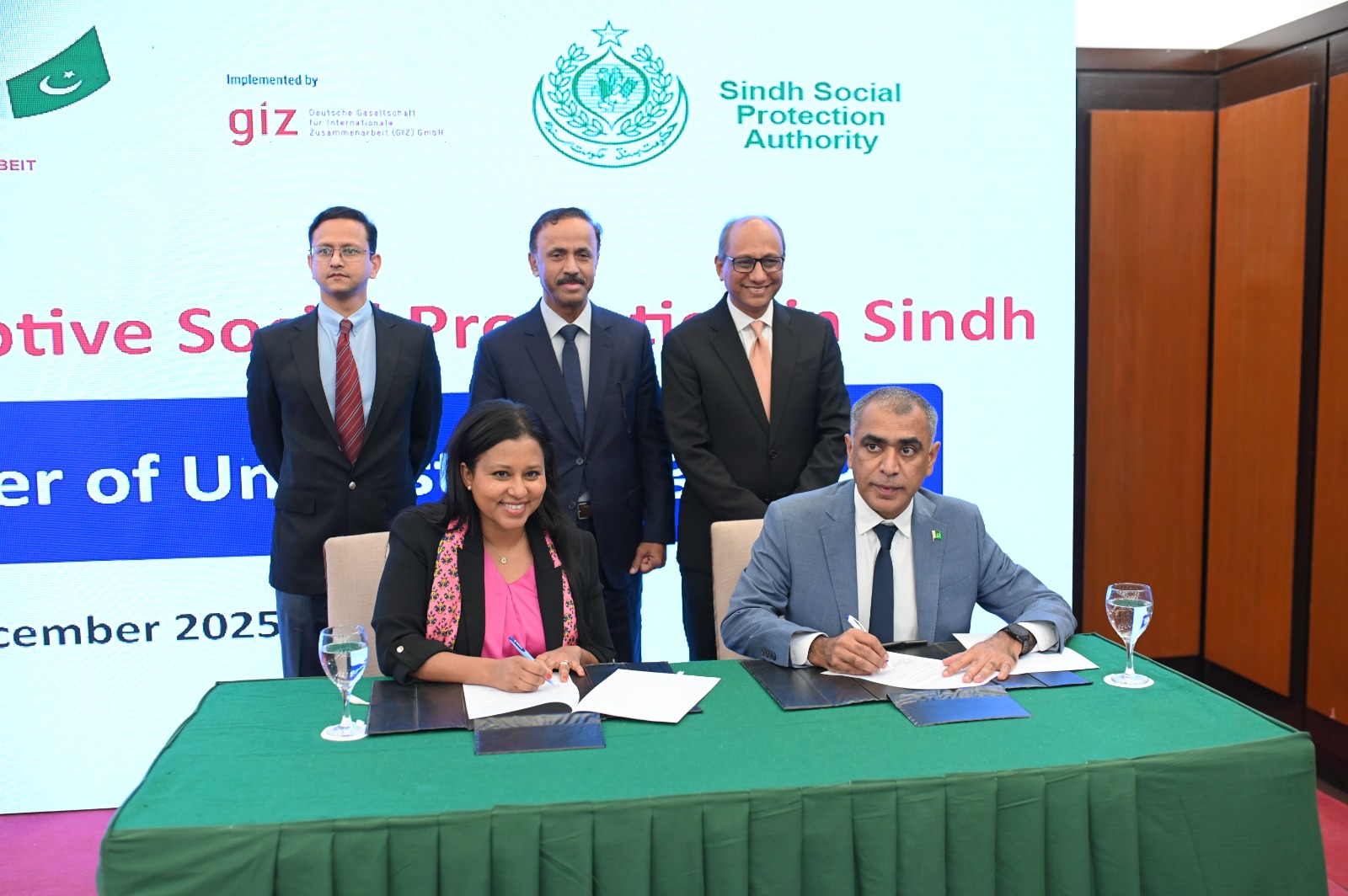
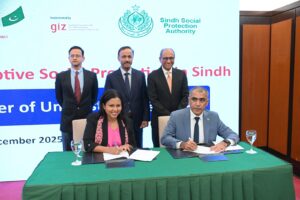
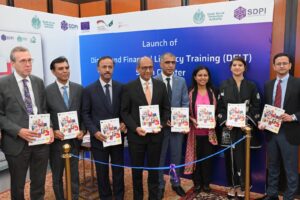
As part of the launch, a Letter of Understanding between SSPA and GIZ was signed by CEO Irshad Ali Sodhar and GIZ ASP Head Johanna Knoess, witnessed by Minister Saeed Ghani. The Minister also cut the ribbon to formally inaugurate DFLT Phase II. A DFLT animated testimonial video was also screened.
Khalid Channa, Secretary Social Protection Sindh extended a vote of thanks to the participants. GIZ Pakistan have committed to further the pilot projects and support government of Sindh in developing a Social Protection Policy for the Sindh government and will establish a joint working group for provinces to have intra-provincial coordination.
He added that this initiative is critical to embrace adaptive social protection in the province and empower women digitally and financially with confidence to contribute in the economic growth.
The event brought together senior government officials, development partners, and implementing agencies, all reaffirming that the DFLT initiative is a key pillar of the EU–Germany–Sindh Government partnership to build an adaptive, equitable, and gender-responsive social protection ecosystem across the province.