




UNICEF, with the support of Global Partnership for Education, and the Government of Khyber Pakhtunkhwa are expanding Integrated Education Management Information System (IEMIS) across Haripur and beyond
Muzzamil had been out of school for two years. His family couldn’t afford school, and no one thought he would ever return.
That changed when his name appeared in the district’s digital school records.
UNICEF, with the support of Global Partnership for Education, and the Government of Khyber Pakhtunkhwa are expanding Integrated Education Management Information System (IEMIS) across Haripur and beyond, transforming classrooms and lives with data-driven solutions that help every child stay in school and learn, because #EveryChildCounts.
https://www.facebook.com/share/p/1C4YLH47CR/
In Haripur, Khyber Pakhtunkhwa, 17-year-old Muzzamil Hussain was missing from school for two years. His parents could no longer afford the private school he attended, and no one in his village thought he would return. Muzzamil quietly disappeared from the classroom.
That changed when his name appeared in the district’s Integrated Education Management Information System (IEMIS) records during a routine data update. Staff at the District Education Department noticed that Muzzamil had previously been enrolled in a private school but was no longer listed anywhere. They traced his record, contacted his family, and referred him to the nearest government school where he was re-enrolled in class 7.
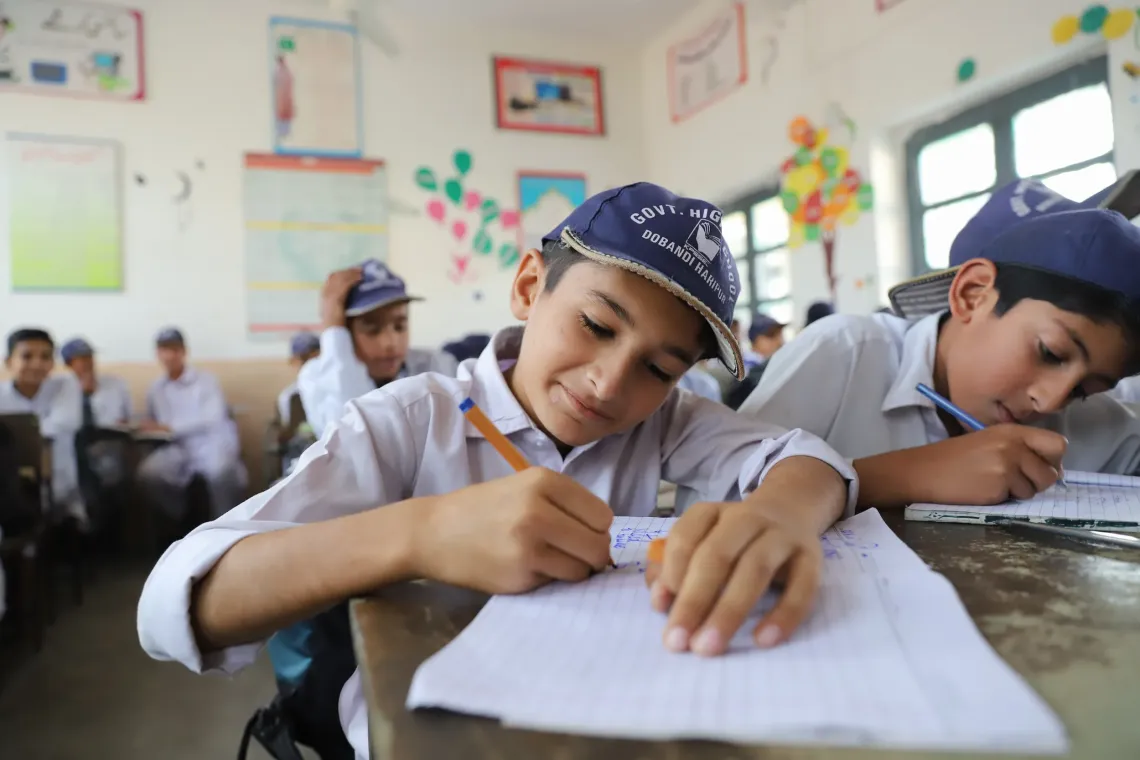
Now, in his white shirt and cap, with his bag slung over his shoulder, Muzzamil walks to school each morning with a smile. After two years away, he is learning, laughing, and dreaming again, this time with a clear goal: to become a teacher.
Muzzamil’s story is just one example of how IEMIS is not only improving education in Haripur but ensuring that children’s learning and wellbeing are supported. Behind the scenes, staff at the District Education Department are using the system every day to make sure no child falls through the cracks.
In the busy office of the District Education Department in Haripur, Assistant Director IT Huma Qauser opens her laptop and smiles. With just one click, she can now access information about every school in the district, from the number of teachers and students to facilities like classrooms, toilets, and clean drinking water.
“It’s all there, accurate and updated. Before this system, we used to do everything manually. It took weeks to prepare a report. Now, I can get it instantly,” she says proudly.
For many years, education data in Haripur was managed through paper files and registers. Information about teachers, students, and schools was scattered across different offices, making it difficult to track needs or plan effectively. Collecting reports from hundreds of schools used to take months, and sometimes data would get lost or duplicated.
To address this, the Government of Khyber Pakhtunkhwa, with support from UNICEF and the Global Partnership for Education (GPE), introduced IEMIS. Today, more than 700 schools in Haripur are using IEMIS to manage everything from enrollment and attendance to infrastructure data and Parent-Teacher Committee (PTC) requests.
IEMIS integrates multiple modules: Human Resource Management (HRMIS), Student Management (SMIS), School/Office Management (S/O MIS), School Self-Reporting (SSR), e-notifications, and the e-transfer module for teacher postings. The HRMIS module records every teacher’s qualifications, experience, and postings, ensuring schools have trained staff where they are most needed.
Huma explains one practical change: “If we identify a surplus teacher in one school and a shortage in another, we can transfer the teacher through the e-transfer module. Earlier transfers happened once a year and involved a lot of paperwork. Now, approvals and transfers are done online with a single click.”
The data system helps schools request funds for local needs. For instance, when floods damaged 19 school boundary walls in Haripur, schools reported the damages through IEMIS. Because the data was already uploaded, the district quickly requested and secured government funds, avoiding losses or delays.
Beyond systems and logistics, IEMIS is helping children return to learning. Deputy District Education Officer Sardar Abdul Qayyum notes, “Earlier, teachers spent hours filling out paper forms. Now, they enter information once, and it can be accessed anytime. That frees up teachers to focus on students.”
Teachers can also track students who miss school or need extra support. “Attendance is automatically flagged,” says Muhammad Farooq Khan, a teacher at Government High School Dobandi. “We can follow up to make sure no child is left behind.”
IEMIS has strengthened evidence-based planning across Haripur. “We can see real-time gaps – whether a school needs more teachers, furniture, or repairs – and allocate resources accordingly. Budgeting and planning are no longer guesswork,” explains Sardar Abdul Qayyum. “Decisions are backed by accurate data.”
The system also ensures safe and well-equipped learning environments. “In seconds, we can see how many desks, toilets, or boundary walls each school has and where repairs or upgrades are needed. This ensures every child learns in a safe space,” he adds.
Across the province, IEMIS now covers all districts, profiling over 5.4 million enrolled children and digitizing records of 240,000 education employees. Detailed information from 34,800 schools has been captured, supporting district and provincial planning. The School Self-Reporting module gradually replaces the annual paper census, enabling near real-time monitoring.
To ensure effective use, 244 provincial and district managers have been trained, followed by cascading support to nearly 4,100 district officials across Khyber Pakhtunkhwa.
Digital systems like IEMIS enable students like Muzzamil to continue their education, teachers can focus on nurturing children’s potential rather than managing paperwork, and administrators can make informed decisions that directly benefit children.
Thanks to funding from the Global Partnership for Education (GPE), UNICEF and the Government of Khyber Pakhtunkhwa are expanding IEMIS across Haripur and beyond, transforming classrooms with data-driven solutions that help every child stay in school and learn.