



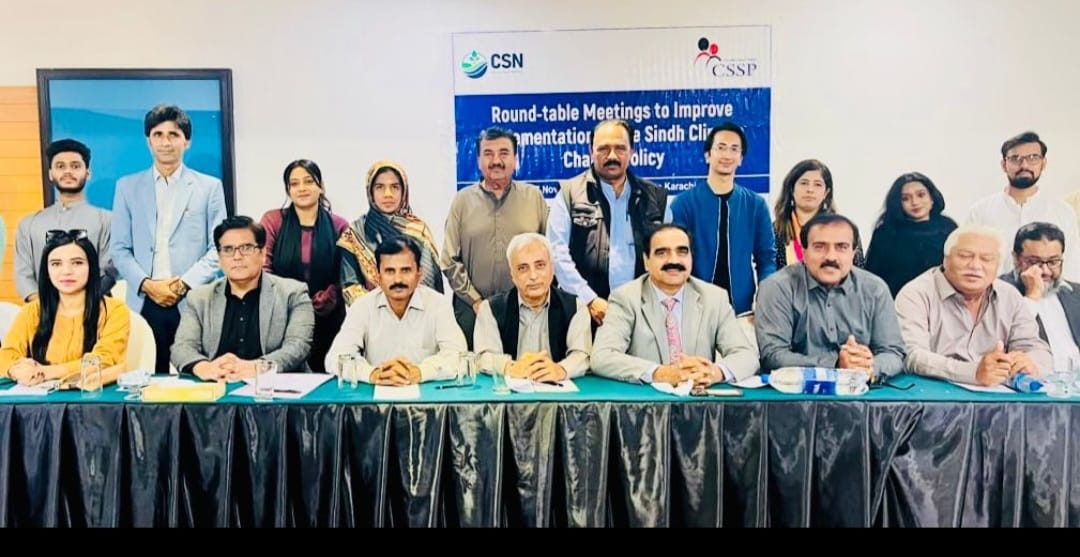
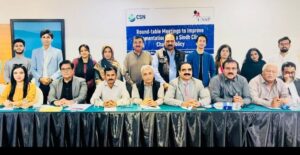
Round Table Meeting held on Climate Change in Sindh in collaboration with SHRD.
Karachi: 30 November.
The Directorate of Human Rights, Government of Sindh has hosted a high-level Round Table Meeting on Climate Change at a local hotel. The session was chaired by Director Agha Fakhur Hussain and attended by senior government officials, development partners, civil society representatives, and climate experts. The meeting was convened by Abdul Wahid Sangrasi, Manager CSSP, and Nawaz Kumbhar, Chairman of the Climate Smart Network.
In his opening remarks, Director Agha Fakhur Hussain stressed that climate change is no longer merely an environmental concern but has become the most pressing human rights challenge facing Sindh. He highlighted that the United Nations now recognizes the right to a clean, healthy, and sustainable environment as a fundamental human right. He further pointed out that the impacts of climate change extend deeply into the rights to life, health, food, water, education, housing, and disproportionately affect women, children, and marginalized communities.
During the meeting, participants reviewed the findings of a recent human rights inquiry conducted in the Manchhar Lake region of Dadu and Jamshoro districts. The inquiry revealed the severe consequences of climate-induced poverty, including widespread loss of livelihoods, population displacement, child marriages, and other human rights violations. The report also found that many affected families face significant barriers in seeking justice due to lack of identity documents and missing school records, which hinder access to essential services.
Speaking on the occasion, Director Hussain emphasized the need for integrated action that places human rights at the heart of climate adaptation policies. He called for immediate deployment of mobile NADRA units in climate-hit areas, the establishment of climate-resilient schools to improve girls’ education, and the strengthening of community-based mechanisms aimed at preventing child marriages. He further underscored the importance of livelihood restoration through fisheries, crafts, small industries, and women-led businesses, along with the provision of climate-resilient housing under the People’s Housing Scheme. Director Agha Fakhur Hussain also reiterated the urgency of enhancing the Sindh Child Protection Authority’s response capacities, particularly during monsoon seasons, and advocated for a dedicated human rights budget within climate adaptation and recovery financing.
In his concluding remarks, Director Hussain stated that “climate resilience without human rights is incomplete, and human rights without climate action is impossible.”