










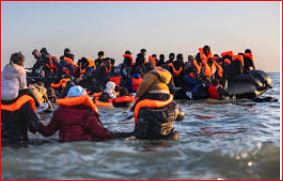
French police to use nets to stop small boat Channel crossings
French police are to use nets to stop small boats leaving the country’s waters in a shift to more aggressive tactics.
Officers will aim to intercept the dinghies at sea by dropping nets in order to snag and stop their propellers and prevent them from crossing to the UK.
It follows a pledge by Emmanuel Macron, as part of an agreement signed with Sir Keir Starmer in July, to adopt tougher tactics to intercept boats in shallow waters within 300 metres of the French coast.
The new strategy has been delayed because of concerns by border officials and police that the tougher approach could put migrants’ lives at risk.
Last month, Martin Hewitt, the head of Border Security Command, revealed that he had expressed his frustration over the delay in introducing tougher tactics directly to the French authorities.
The move came as Yvette Cooper, the Foreign Secretary, secured an agreement for Germany to introduce a new law in December to enable its police to prosecute small-boat smugglers who store their dinghies in warehouses in the country. A loophole in German law had prevented such prosecution.
More than 39,000 migrants have crossed the Channel so far this year
More than 39,000 migrants have crossed the Channel so far this year Credit: Carl Court/Getty Images
The Telegraph revealed last week that French police were preventing fewer migrants from crossing the Channel since Sir Keir struck the deal with Mr Macron.
Just over a quarter (28.7 per cent) of migrants’ attempts to make the crossing have been stopped by French officers since the agreement was implemented in August.
Now, with more than 39,000 migrants having crossed the Channel so far this year, the French authorities are planning to test the new net strategy.
French border vessels will try to overtake the “target” dinghies before releasing the net 15 to 25 yards ahead of them to neutralise the boat by snagging its engine’s propellers. A source said: “With nets, there’s no collision, no waves.”
The French police are expected to initially target the more lightly loaded “taxi boats”, which are steered up the coast after being launched in rivers or other waterways to pick up migrants who wade into shallow waters to get on board.
More than 56 per cent of migrants who have reached the UK in 2025 used taxi boats, according to the northern French prefecture.
An interior ministry official told Le Monde: “There will be five or six teams [along the coast], each made up of a gendarmerie maritime boat for interceptions and a French navy vessel positioned in case a rescue is needed.”
Another ministry source specified that “at first, there will be only one interception unit. Staff still need to be trained, but the idea is to build up capacity”.
French sources said the authorities were fully aware of the risks inherent in such tactics being deployed at sea. This autumn, an average of 70 people are boarding poorly-built small boats.
Twenty-six people have died attempting the crossing since January, according to the prefecture. Most deaths occur near the coast, resulting from drownings or asphyxiation aboard overcrowded dinghies.
“The manoeuvre will be extremely difficult,” a police source told Le Monde. “It’s not going to be very forceful – no one wants to take unnecessary risks.”
A company providing the nets told the French newspaper that “the main risk is the risk of collision”, adding that “the responsibility to avoid collision lies with the interceptor boat”.
French sources said the authorities were fully aware of the risks inherent in more aggressive tactics being deployed at sea
French sources said the authorities were fully aware of the risks inherent in more aggressive tactics being deployed at sea Credit: Gareth Fuller/PA
The deal with Germany closes a loophole under which facilitating people-smuggling is not technically illegal there if it is to a third country, which the UK is after Brexit. The change, to be passed into law on Dec 19, will mean police can start prosecuting in the new year.
Ms Cooper said: “Together with Germany, we are taking new action to stop illegal small boat crossings, to strengthen border security and to go after the criminal smuggler gangs who have been storing boats and equipment in German warehouses.
“As a result of the landmark treaty we signed earlier in the year, Germany is now set to change its law by Christmas so our police can jointly go after the smugglers and traffickers and their vile trade in human lives.”
courtesy www.telegraph.co.uk